Wednesday, 13 June 2018

BORING NEWS SINCE THE 14TH GENERAL ELECTIONS

News and commentaries carried by media on both sides of the political spectrum were so exciting in the run up to the 14th general elections on 9May 2018 but after the Pakatan Harapan victory in capturing the federal government, news has gotten very very boring and predictable with reports mostly focused on the number of expensive handbags, jewellery. watches, gold bars and wads of cash in seized from former prime minister Datuk Seri Najib Tun Razak's residences, family members' apartments and safe houses and whilst it is perfectly justified to ask where the money came from to purchase all these items, however no solid evidence that crime was involved in the acquisition of these items. Besides that, are reports of new prime minister Tun Dr. Mahathir's cancellation of the High Speed Rail, plans to revive the national car project and so forth.

However I burst out laughing uncontrollably at what writer Joe Najib (not sure whether he is related the former prime minister) wrote in an article published by The Third Force - a Najib supporter.

"Soon enough Guan Eng pergi berak pun invite media nak bagi tau taik dia colour apa."

Transaltion:-

Soon enough Guan Eng (the finance minister) goes take a shit and invites the media to be informed of the colour of his faeces.

Article follows


It’s time for a Third Force – The Third Force

Raggie Jessy

Joe Najib

Without realising, we’re actually seeing the REAL ugly side of our country’s politics exposing itself. Bit by bit. Both sides.

BN is in total disarray. UMNO folks are busy throwing and offering themselves as candidates, creating bigger fractions even at the very top. Semua nak rebut kuasa.

Untuk apa? Tanya diri – untuk apa sebenarnya? Nak tegakkan martabat Melayu? Nak bantu kaum Melayu dalam kehidupan harian mereka? Ataupun ada agenda yang tak semurni tujuan sebenar? Are you collectively moving towards being better? A REAL change? Or are you building yourselves again to be exactly what you were before? Tanya diri baik2.

MCA? MIC? What’s the story? Senyap je. Only WKS is being vocal. Tired of playing second fiddle to the leading component party? What are your plans? Where is the integration? Did your political beliefs and purpose die together with the election results?

Face it. Barisan Nasional needs a serious restructuring. If race-based political parties need to be dissolved, DO IT! Are you too thick-headed to accept that there are always other ways to (genuinely) look after the interest of your respective races without it being overly-political in nature? And that there are ways to do so without offending or sidelining the other races?

Hai, kalau niat tu murni dan ikhlas, banyak alternatif boleh explore.

I’m sure the breakthrough solution is a few think-tank sessions away. Headed by REAL thinkers, not freaking warlords as old as Parameswara.

I see government supporters smiling.
You wait. I’m not done.

We have seen and heard NOTHING but condescending statements from the gazillion press conferences made to date. Soon enough Guan Eng pergi berak pun invite media nak bagi tau taik dia colour apa.

HSR scrapped to HSR postponed?
MRT3 scrapped but instead must add buses?
Jual negara to China but now begging for Japanese Yen??
Country going bankrupt but can afford to give 3 months of tax break?
Cronies coming back to build resorts, airports and ANOTHER car maker?
DSN so convincingly guilty for 1MDB with solid evidence from day one, but now can’t even charge him? While a person that’s already charged in court is made a minister? What, not even going to TRY to investigate further?? Or is that why you chose a certain AG to be appointed, to conveniently drop all charges?

How much more kencing (urine) you want to spray on your supporters and the rakyat?

Dua-dua macam lahanat.

A third force is due.

If there’s a movement out there that’s heading towards an honest, progressive thinking direction, I am offering myself to be part of it. I need to be among people who listen, people I can listen to, people who are genuine in all intents and purposes.

And please, don’t tell me the current government is honest. You must be naive to think that old man has changed. Naive tahap dewa (Naive like an angel).

Don’t like what I have to say?

Too bad. Go follow Cartoon Network.


Yours trully

POLITISCHEISS


Friday, 18 May 2018

IT WAS MORE OF A TUNAMI THAN A TSUNAMI, Y.B. DR. ONG KIAN MING! - Re: (17 May 2018) GE14 – A truly Malaysian Tsunami

Dear Y.B. Dr. Ong Kian Ming,

Thanks for your commentary. However, you seem to ignore economic factors, especially  since the 2013 general elections, which had burdened all Malaysians from the urban centres to the most remote rural villages, the rural and semi-rural areas having delivered the number of seats in parliament in the past, thus enabling Alliance, then BN to rule continuously in the 61 years since Malaya achieved independence.

Prices of goods in the stores had been rising, even before the introduction of the GST on 1 April 2015, which added to the burden, especially upon the lower income group, many of whom were traditionally UMNO/BN voters. I recall a time when a can of Ayam brand tuna costs RM3.60 and today it costs around RM6.00.

I have heard accounts of rural people complaining to Mahathir that where they previously could afford to eat three meals a day, now they can afford only two a day, and they looked towards him winning as enabling relief of their plight.

History testifies that dire economic conditions is the stuff which has driven revolutions - such as the French and Russian Revolutions of February and October 1917.

Dire economic conditions upon the people, also drove the electoral victory of the Fascists in Italy and the National Socialists in Germany, whilst tough economic conditions drove the fall or Marcos, the fall of Soeharto, the Arab Spring uprisings in Tunisia and Egypt, more recently the rise of the populist far right in Europe, the election of Donald Trump and now the Pakatan victory in Malaysia.

Also in Malaysia, the grievances of the FELDA settlers drove many of them to vote against the BN.

Thus despite the redelineation of electoral boundaries which would have favoured the BN under more normal conditions, however in GE14, the pain of economic burdens drove those who traditionally had voted UMNO/BN instead voted Pakatan.

Then, let us not forget what I call the "Mahathir Effect", where Mahathir loyalists amongst UMNO voters would vote BN when Mahathir was in UMNO/BN but now that his party Pribumi is part of Pakatan, they voted Pribumi, or for the candidate of another Pakatan party where Pribumi did not stand.

The Mahathir Effect basically split the UMNO/BN vote, thus enabling Pakatan candidates to win the seats contested, many of them with the largest minority of votes in their constituency, for example Dr. Haniza Talhar of PKR who won Lembah Jaya with the largest minority of votes.

Credit must also be given to Mahathir and Rafizi Ramli for going down and campaigning in UMNO/BN's rural heartlands.

This is in stark contrast to mostly urban and semi-rural based Pakatan politicians, especially from DAP and PKR, who appeal mostly to middle class, urban voters, with issues such as 1MDB, Altantuya, Scorpene submarines,corruption, cronyism, nepotism, press freedom, human rights, meritocracy and so forth which are not top priorities for those struggling to make ends meet.

Thus, rather than being a tsunami, the Pakatan victory in GE14 was very much a "Tunami", since without Tun Dr. Mahathir in Pakatan, you would still be in opposition post GE14 and blaming blackouts at polling stations, 40,000 Bangladeshis being flown in to vote, "ignorant" rural voters who are "easily bought off" with handouts of RM50 and so forth to vote BN.

However, that is not to say that issues such as 1MDB, Altantuya, Scorpene submarines,corruption, cronyism, nepotism, press freedom, human rights, meritocracy and so forth are not important issues. My point has always been that whilst these issues are uppermost in the minds of relatively, comfortably well off, educated, English literate, social media savvy, urban middle class voters, who seemingly have the luxury of time to discuss such issues on social media, in teh tarik and bar talk, however these issues are not top priority amongst the lower income urban and rural voters who had traditionally delivered the winning number of seats in parliament to the BN.

That said, I'm glad that our new Prime Minister Tun.Dr.Mahathir is taking action to address the above issues, though I hope that the now Pakatan federal government, as well as the Pakatan state governments will also address those issues which affect us ordinary citizens on the ground.

You guys and gals are the government now, so you had better give up your "opposition as barking watchdog" mindset and learn to govern well.

CONGRATULATIONS ON YOUR VICTORY!

Yours trully

POLITISCHEISS

-----Original Message-----
From: "Dr. Ong Kian Ming, Member of Parliament for P102 Bangi" REDACTED>
Reply-to: Dr. Ong Kian Ming, Member of Parliament for P102 Bangi <REDACTED>
To: IT.SCHEISS
Subject: (17 May 2018) GE14 – A truly Malaysian Tsunami
Date: Thu, 17 May 2018 08:50:17 +0000

Media Statement by Dr. Ong Kian Ming, Assistant National Director for Political Education for the DAP and Member of Parliament for P102 Bangi, on the 17th of May, 2018

GE14 – A TRULY MALAYSIAN TSUNAMI
(Image Credit: Amanah Daily)

This media statement can also be read here (link)


When I returned to Malaysia from the United States after the completion of my PhD in 2010, I made a presentation where I said that the opposition was not likely to win GE13 but would take power in GE14. I must admit that even on the eve of polling day on the 9th of May, 2018, I was not 100% confident that Pakatan Harapan would be able to win a majority of parliament seats in GE14. The delimitation exercise which was bulldozed through parliament in March, the expected three corner fights with PAS, the seeming inability for the opposition to break through in Sarawak and the expected fear mongering by the BN among the Malay voters were the main reasons for my doubts.

What Najib and the BN did not count on was the creation of a Malaysian Tsunami which, to their utter shock and horror, swept the BN out of office, not just at the federal level but also in all of the states with the exception of Perlis and Pahang.[1]

BN’s share of the popular vote in Malaysia (including Sabah and Sarawak) nosedived by 12.8%, from 46.7% in GE2013 to 33.9% in GE2018 (Table 1 above). To put this figure into context, BN’s vote share in GE2018 was far lower than the 46.2% of the popular vote it (contesting as the Alliance Coalition) managed to win in Peninsular Malaysia in the 1969 general elections, which was already considered a disastrous performance.


Table 1: Share of and Change in Share of Popular Vote in Malaysia (GE2013 vs GE2018)
Pakatan Harapan emerged as the largest coalition with 48.3% of the popular vote. Some analysts have used the fact that PH failed to win a majority of votes to say that PH does not command the support of a majority of supporters in Malaysia. These same analysts also try to lump together the total support for BN and PAS to say that more than 50% of the voters did not support PH in GE2018. This interpretation totally misses the mark. The results of GE2018 was all about the backlash against the BN. 65% of voters voted AGAINST the BN and threw their support behind parties that were NOT the BN. Almost two thirds of voters in the country voted AGAINST the BN because that is how badly they wanted BN out of power at the federal and state levels.

The anti-BN swing was felt in ALL of the states in Malaysia. The largest swing against the BN occurred in Kedah where support for the BN fell by 19.8% from 49.8% in GE2013 to 30% in GE2018. Double digit swings against the BN were also experienced in Selangor, Johor, Perlis, Melaka, Negeri Sembilan, Sabah, Wilayah Persekutuan (KL & Putrajaya), Perak and Terengganu. (Figure 2 below)

In fact, the only state where the BN won more than 50% of the popular vote was in Sarawak, with 52.7% of the popular vote. (Table 2 below)
Figure 1: Change in BN support (Parliament) GE2013 to 2018
Table 2: Change in BN support (Parliament) GE2013 to 2018
Unlike in GE2013 where Malay support for the BN actually increased slightly compared to GE2008, there is no question that the Malay voters abandoned the BN in unprecedented numbers. Even many of the civil servants voted against the BN. Tengku Adnan, the former Minister for the Federal Territories, won his Putrajaya seat with only 49.5% of the popular vote in GE2018. This was a seat which he won comfortably in GE2013 with almost 70% of the popular vote.

There is strong evidence to suggest that even the police and army voters abandoned the BN in significant numbers. The four parliament seats with more than 10,000 early voters (mostly police and army voters) were all won by Pakatan Harapan (Table 3 below). Two of these seats – Setiawangsa and Tangga Batu – were won by the BN in 2013. The parliament seat of Lumut was gerrymandered to make it easier for UMNO to win back this seat. 10,000 police voters were moved into the Lembah Pantai parliament seat. Without a significant number of police and army voters NOT supporting the BN (either voting for PAS, PH, spoiling their votes or not casting their vote), PH would not have been able to win these parliament seats.
Table 3: Parliament seats with more than 10,000 early voters all of which were won by PH (GE2018)
In my own constituency of P102 Bangi, out of the 1305 postal votes which were cast (mostly army votes), 471 went to the PAS candidate (36.1%), 409 went to the myself, the PH candidate, (31.1%) and only 299 went to the BN candidate (22.9%). I was shocked when I saw these results. I won’t be surprised if the results in many of the other seats with a high number of postal and early voters also shows that a significant proportion of the army and police votes were cast NOT in support of the BN.

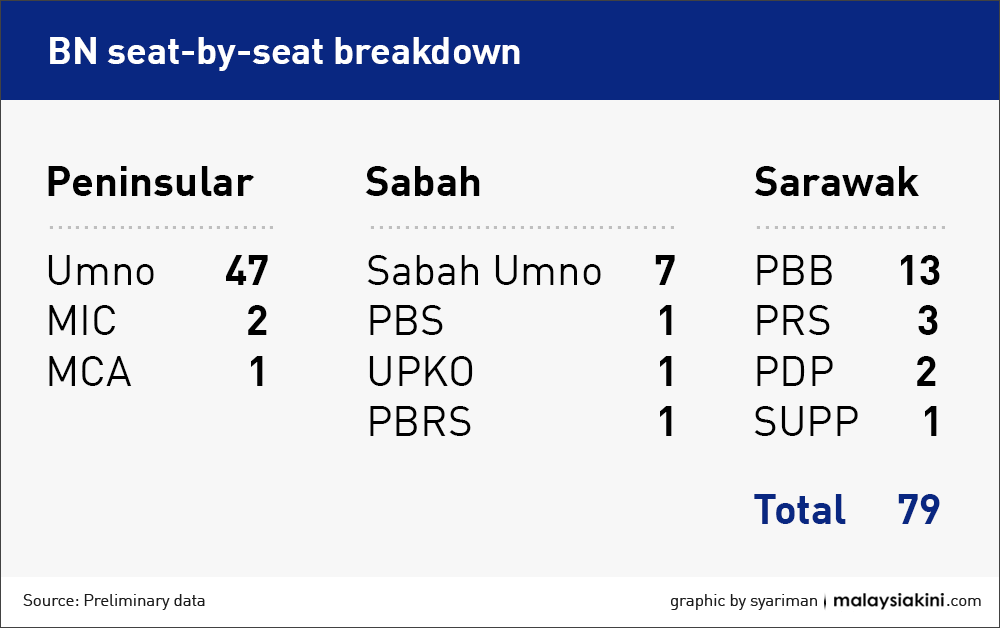
Pakatan Harapan performed very well in the ethnically mixed or ‘heterogeneous’ parliament seats. These are seats where no one race comprises more than 70% of the electorate. Out of the 83 mixed parliament seats, Pakatan Harapan won 73 or 88% with BN winning the remaining 10 (UMNO 7, MIC 2 and MCA 1). PAS did not win a single ethnically mixed parliament seat. These constituencies have become and will become increasingly important in Malaysia’s electoral landscape with increasing migration to urban areas. If the constituency delimitation were done fairly, such mixed seats would easily comprise 60% to 70% of total parliament seats in Peninsular Malaysia. Only a coalition with the ability to win the support of all the ethnic groups can hope to win such seats.

Last but not least, this Malaysian tsunami could not have happened without the voters in Sabah and Sarawak. While I was confident that Warisan together with DAP and PKR would make headway in Sabah, I did not imagine that PH together with Warisan would win 14 out of 26 parliament seats as well as 29 out of 60 state seats in Sabah.[2] What was more unexpected was the fact that the opposition would capture 12 out of 31 parliament seats in Sarawak[3] including a few semi-rural and rural seats such as Mas Gasing, Puncak Borneo, Saratok and Selangau.

With urban and rural voters, Malay and non-Malay voters, Peninsular Malaysia and East Malaysian voters, the civil service, the police and the army all rejecting the BN in record numbers, history was made and for the first time in 61 years, Malaysia has a new federal government. The question now is whether Pakatan Harapan can hold on to these gains and expand our influence to places where we performed poorly in notably Kelantan and Terengganu. But that is for another statement. For now, the focus for PH is to deliver on our manifesto promises and show that voters that we are a government which can truly deliver for the people.  


Copyright © 2018 Democratic Action Party, All rights reserved. 

Friday, 11 May 2018

CONGRATS PAKATAN AND MAHATHIR

Congratulations to Pakatan Harapan for winning the 14th General Elections and forming the Federal Government, and congrats to Tun Dr. Mahathir on his comeback as Malaysia's Prime Minister.

This is a New Dawn for Malaysia which I never expected to see during my lifetime.

Malaysia's fourth Prime Minister Tun Dr. Mahathir has made a comeback as Malaysia's seventh and first Pakatan Prime Minister, thus confirming that Pakatan Harapan will form Malaysia's next federal government.

The YDP Agong (the King) swore Mahathir in as Prime Minister at 9.30pm on 10th May 2018, after the palace had consulted with leaders of the various Pakatan parties as to their acceptance of Mahathir as PM.

Mahathir went to the Palace at 5.00pm on 10 May 2018 for the swearing in ceremony but there was no news of his swearing in on TV, so people began to get suspicious and there was plenty speculation, suspicions and allegations on social media that the palace was delaying or blocking his premiership.

However, the reason was that Barisan Nasional is officially registered as a political coalition with the Elections Commission, which had made it easy for the Palace to accept the candidate put forward by the coalition as Prime Minister,  whilst Pakatan Harapan is an unofficial pact between parties, so each member party had to be consulted before Mahathir's choice as Prime Minister could be accepted by the Palace.

Below is the a press release by the National Palace explaining the delay and confirming that Mahathir would be sworn in at 9.30pm on 10 May 2018.
(If you cannot see the embedded images, please enable 'view images' in your e-mail client)


Mahathir was finally sworn in as seen in this Star TV2 video
"It's official! Tun M sworn in as 7th Prime Minister"

The Star also reported on Mahathir's first press conference after being sworn in as PM.


Pakatan to meet on Cabinet lineup, says Dr M, while promising 'heads will roll' - Nation

by tarrence tan and victoria brown 


PETALING JAYA: Newly-minted Prime Minister Tun Dr Mahathir Mohamad says Pakatan Harapan will be discussing its Cabinet lineup on Friday, while promising "some heads will roll".

At his first press conference as Prime Minister, Dr Mahathir vowed that the heads of certain government departments will fall.

"The heads of certain departments must fall. We find that some people are aiding and abetting the former prime minister who was described by the world as 'kleptocrat'," he said told a press conference at a hotel here Thursday (May 10) night.

He said he would be convening a Pakatan presidential council meeting on Friday (May 11) to discuss the new Cabinet lineup.

"Tomorrow, there is a holiday. But I will not take any holiday.

"Tomorrow we'll have a meeting because we need to discuss the formation of the Cabinet," he said.

Dr Mahathir said that the meeting would consider all the views of Pakatan component parties on a number of issues, which includes policy decisions.

"It will be a very busy time. I will not be going back at 4am. I normally go back at 6am. But, maybe I'll have to extend to 7am," he quipped.

At a press conference earlier Thursday, Dr Mahathir said he would appoint PKR president Datuk Seri Dr Wan Azizah Wan Ismail as deputy prime minister once he is sworn in.

Dr Mahathir also said that the Pakatan-led Federal Government would review previous charges on political leaders, as some of these charges could have been politically motivated.

"We need to look if there is a case. If there is no case, we want to see how we can look at these cases based on the laws of the country."

He also said the new administration would review laws that are oppressive and unfair.

Earlier Thursday, Dr Mahathir was officially sworn in as Malaysia's seventh Prime Minister.

He took his oath of office before Yang di-Pertuan Agong Sultan Muhammad V at the Istana Negara at 9.57pm.

The 93-year-old was accompanied by his wife Tun Dr Siti Hasmah, Dr Wan Azizah, DAP secretary-general Lim Guan Eng, Parti Amanah Negara president Mohamad Sabu, Parti Pribumi Bersatu Malaysia president Tan Sri Muhyiddin Yassin and PKR vice-president Nurul Izzah Anwar.


You may also want to check out Malaysiakini's guide to the victory.


KiniGuide: GE14 numbers - what it means for BN, Harapan and PAS?


GE14 | A new government, comprising a coalition of perhaps five parties, is set to be sworn into Putrajaya.

The main part of this coalition is Pakatan Harapan, which comprises PKR, DAP, Bersatu and Amanah, and the Sabah-based Warisan.

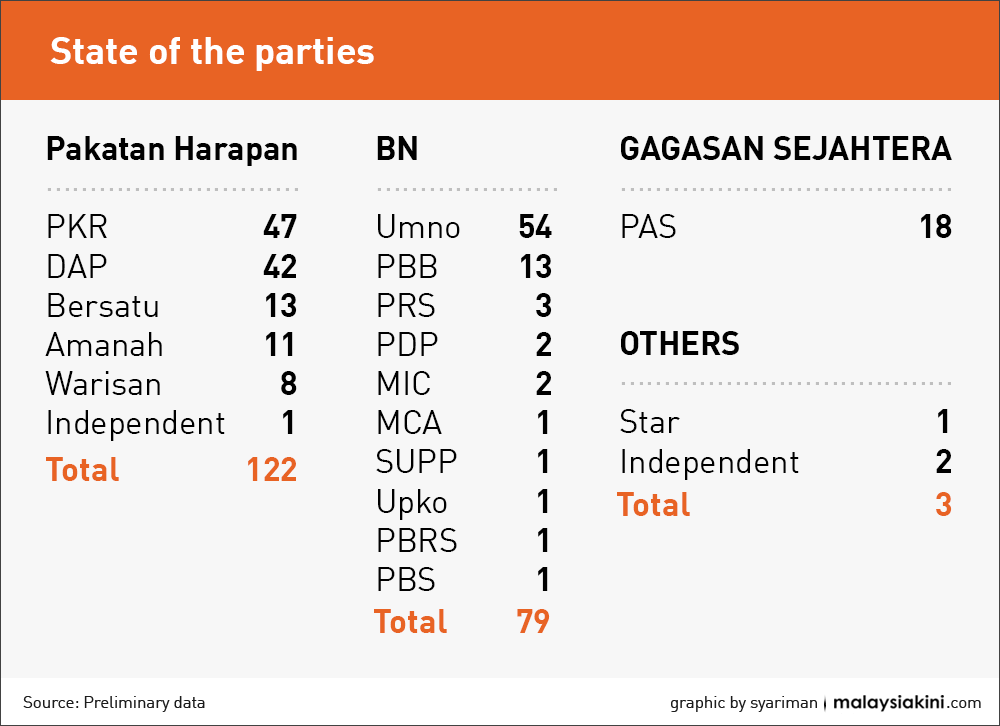
At the conclusion of the 14th general election, PKR won 47 seats, DAP 42 seats, Bersatu 13 seats, Amanah 11 seats and Warisan eight seats.

In total they make up 121 parliamentary seats, enough to form a stable government. If the PKR-backed Batu MP P Prabakaran is counted, the number climbs to 122.

There are also three other players. One is independent Julau MP Larry Sng, who won due to an informal deal with Harapan which saw the coalition giving way to him for a direct fight against PRS.

The other is independent Lubok Antu MP Tambat @ Jugah Muyang, who pulled off a surprise win against PKR and BN.

The third is Jeffrey Gapari Kitingan, who is part of Star, which may form a coalition government with Harapan and Warisan in Sabah due to a hung assembly.

If these three join forces with Harapan at the federal level, then the coalition's number can be as high as 125 seats.

What does it mean for Harapan?

For one, PKR has emerged as the largest party of Harapan. This would allow the coalition to dispel the often repeated claim by BN that it was "dominated" by DAP.

PKR's big boost in the parliamentary seats it won was largely due to the party contesting in mixed seats. 

A Malay wave of revolt coupled with strong Chinese support helped PKR to gain additional 17 parliamentary seats compared to the last general election.

While Bersatu and Amanah also rode on the Malay wave, they typically contested in seats which have big Malay majorities.

However, with fewer anti-establishment Chinese voters in such constituencies, they could not sufficiently mitigate the PAS factor.

What does it mean for BN?

BN won a total of 79 parliamentary seats in the 14th general election.

In Peninsular Malaysia, BN is almost non-existent apart from Umno, which captured 47 seats here.

The MCA saw its seven parliamentary seats reduced to one.

MCA deputy president Wee Ka Siong became the party's sole MP.

Meanwhile, the MIC's parliamentary seats were halved from four to two while Gerakan was wiped out. 

The two MIC seats were won by M Saravanan in Tapah and C Sivarraajh in Cameron Highlands.


All three party heads, namely MCA president Liow Tiong Lai, MIC president S Subramaniam, and Gerakan president Mah Siew Keong were defeated.

Their defeat will likely see a renewed period of uncertainty in the BN component parties and possible internal transition of power favouring the few who survived the general election.

In Sarawak, Umno does not exist, as BN there is led by PBB.

The breakdown of seats in Sarawak after the 14th general election is PBB 13, SUPP 1, PRS 3 and PDP 2.

In Sabah, Umno has seven seats, however, its partners there have also been severely weakened, with PBS, Upko and PBRS all only winning one seat each.

With BN severely weakened and almost reduced to only Umno, it remains to be seen if its East Malaysian component parties will remain in the coalition.

The formation of a new East Malaysia coalition cannot be ruled out.

The outcome of the general election could see a realignment of parties and possible mergers.


What does it mean for PAS?

In the run-up to the general election, Harapan had been touting a "Malay Tsunami" while PAS touted a "Green Tsunami".

Both sides were to some extent right, as Harapan swept the west coast while PAS swept the east coast of Peninsular Malaysia.

BN lose a substantial number of voters to Harapan and PAS, with one getting more than the other depending on states.

PAS remains a relevant force, having won 18 parliamentary seats and is a kingmaker in Perak where there is a hung assembly.

Prior to the general election, there had been many overtures between PAS and BN with talks of forming a Malay Muslim-only government.

Following the general election, even if BN and PAS were to join forces at the federal level, they will only have 97 seats, which is not enough to form the government.

And even if Bersatu decides to recombine with Umno, which is unlikely as it has already won power, the three parties would have a total of 110 parliamentary seats - two short of a majority.

Furthermore, a mono-ethnic, mono-religious coalition will not be acceptable to East Malaysian parties, which could quit the BN as a result.

What's the popular vote in GE14?

According to preliminary data, no single party garnered more than half of the popular vote due to widespread multi-cornered fight.

The preliminary calculation showed Harapan won around 45 percent of the popular vote followed by BN with 32 percent and PAS by 16 percent.

The remaining was won by other smaller parties or independents.


Pakatan Harapan comprises four parties in Peninsular Malaysia, an independent winner and Warisan (Sabah Heritage Party) in Sabah.

Formerly the Alliance Party, Barisan Nasional in Peninsular Malaysia has seen its MCA member win only one seat, whilst its MIC member won two. Gerakan and PPP got no seats. The rest of BN members are in Sabah & Sarawak, so UMNO is the dominant BN member in Peninsular Malaysia.

Pakatan's ethnic representation is much better balanced than BN's.

So we hopefully will be able to look forward to improved inter-ethnic and inter-religious relations under Pakatan.

However, the road ahead will not be smooth sailing for the Pakatan government, especially in the face of external economic factors which may impact upon Malaysia.

There's also plenty of undoing of undesirable legacies left behind by past BN rule.

Also, at our local level, we will still have to continue to push and shove our Pakatan elected representatives to act upon local matters affecting us.

Fortunately, our very helpful and supportive Selangor State Assemblyman, Y.B. Rajiv Rishyakaran of Pakatan/DAP, successfully defended his Bukit Gasing state constituency whilst Maria Chin, running for office for her first time, successfully defended our Petaling Jaya federal constituency (formerly Petaling Jaya Selatan or 'Petaling Jaya South' in English) for Pakatan/PKR to become our Member of Parliament. In this general elections, all candidates of Pakatan member parties in Peninsular Malaysia contested under the banner and logo of Pakatan member party PKR (People's Justice Party)

So now they have no more excuses that as Pakatan state assemblymen or assemblywomen, their abilities to act for us are limited by the Barisan Nasional federal government, since Pakatan now also is the federal government.

Meanwhile, Pakatan won 51 of the 56 seats in the Selangor State Assembly - a landslide win. The pact also won 20 of the 22 parliamentary seats in Selangor.

Pakatan also won Johor state, which was the birthplace of UMNO (United Malays National Organisation).

So now that the elections are over and Pakatan is now the federal government, it has to deliver on its election promises to the people and prove that it can govern well and serve our interests.

As for Mahathir, he was Malaysia's fourth Prime Minister for 22 years, when he ruled as a BN/UMNO Prime Minister but he recently resigned from UMNO, formed his own party Parti Pribumi Bersatu Malaysia or 'Bersatu' or 'Pribumi' for short. During his 22 years he did much good for Malaysia but at the same time laid the foundations for much of what is wrong in Malaysia, during his time and also under his successors. He has said that if elected, he will work to undo that wrong, so it is left to be seen as to how well he will live up to that promise, now as Malaysia's seventh Prime Minister and a Pakatan Prime Minister this time round.

I grudging supported Mahathir in how he handled financial manipulation of Malaysia's currency by foreign currency speculators, especially during the Asian Economic Crisis of 1998 and by pegging the Malaysian Ringgit at RM3.80 tot he U.S. dollar, he enabled Malaysian businesses to quote for projects based upon a predictable exchange rate, since many of these projects involve imported equipment and materials which are quoted and billed in U.S. dollars.

Mahathir's move enabled Malaysia to survive the Asian Economic Crisis relatively well and by making the Ringgit inconvertible to foreign currencies outside Malaysia, Mahathir managed to fend off manipulation of the Ringgit by foreign currency speculators.

It was inconvenient for me, no doubt, especially since I travelled overseas quite often back then and had to convert my money to foreign currency before leaving Malaysia but I was willing to put up with that inconvenience.

The mid-1990s before the Asian Economic Crisis was a golden age of sorts for Malaysia's economy, with employment opportunities galore, businesses booming and a much optimism for the future in the air. However, even after the Asian Economic Crisis hit and those go go days were over, however living costs did not rise to burden the ordinary people like in recent years. Like back then, the price of a can of tuna used to cost around RM3.60 but today it costs close to RM6.00 today.

The Ringgit exchange rate was around RM2.60 to the U.S. Dollar in the mid-1990s, compared to RM3.95 today, thus making imports of finished products or components more expensive domestically.

The weak ringgit has been blamed upon the plunge in the price of Brent Crude oil in late 2014, after which which has remained between US$40 and US$50 a barrel until it rebounded in early 2017 to US$77 per barrel today and the strength of the Ringgit shows a correlation to the price of Brent Crude over these past  few year.

However, the price of Brent Crude was between US$18 and US$19 per barrel in April, May and June 1996, whilst the Ringgit was around US$2.5 to US$2.7 at the time, so this correlation appears to have not applied backthen.

I disagree with how Mahathir's Deputy Prime Minister Anwar Ibrahim was treated following his fall out with Mahathir and his sacking from UMNO in 1998 and with some of the draconian measures such as the Ops Lallang detentions of political activists and opponents during Mahathir's earlier time as Prime Minister.

Mahathir was no angel back then and now that Mahathir and Anwar are allies again, hopefully Mahathir will deliver on his promise to have Anwar pardoned for his convictions sent him to jail and hopefully, they will be able to work together amicably for the sake of Malaysia and Malaysians. 

Apart from undoing the wrongs with Malaysia, one of the first things the new Mahathir-led government must do is to lower the cost of living.

I'm pretty sure that Mahathir will refocus on his pet initiatives such as the National Car and Multimedia Super Corridor (MSC Malaysia) initiative to develop Malaysia's information technology and multimedia industry. MSC Malaysia appears to have been given a lower priority during the time of Mahathir's successors, so I expect that he will now intensify the government's focus and resources on MSC Malaysia.

As for the Proton National Car project, I how that Mahathir will accept that it is very difficult especially for an relatively new automotive manufacturer from a relatively small developing country such as Malaysia to break into and competed with globally established automotive giants in a mature automotive market which has been consolidating over the past years.

When the established Swedish automotive maker AB Volvo has to sell off its Volvo Cars subsidiary to China's Geely, whilst AB Volvo focuses on trucks, buses, marine diesels, generator sets and soforth, and whilst Ford in the U.S. recently announced that it would be cutting back on its number of car models to two, whilst it focuses on producing trucks, utilities and commercial vehicles, with General Motors expected to follow soon after; this goes to show that the volume car market - essentially a consumer market, is highly saturated and no longer lucrative for these long established automotive pioneers, which are now proverbially moving up the value chain to lower volume, higher value industrial and commercial vehicles, engines and machinery, so the prospects for relatively new a volume car maker such as Proton to survive and thrive in the global volume car market, appear rather bleak, especially when Malaysia has a relatively small domestic car market.


It is for this same reason that computer equipment manufacturers and information systems suppliers such as IBM have disposed of their PC business to the likes of China's Lenovo, whilst established telecommunications giants such as Alcatel, Siemens, Ericsson and other have divested their mobile phone business to manufacturers in China, whilst they concentrate on their higher end and more lucrative telecommunications equipment business.
  
Therefore, letting Proton go into the hands of an volume car maker such as Geely which can sell into the huge China domestic market may be the best option to preserve the jobs of Proton workers, whilst relieving Malaysia of the burden.

Hopefully, Mahathir will consider these points moving forward.
Yours truly

POLITISCHESS


Saturday, 21 April 2018

OH WHAT A RELIEF! TIME TO TAKE A BREAK FROM ALL THE NOISE AND THUNDER SINCE 2013 - QUE SERA, SERA!

Hurrah! At long last, Malaysia's general elections is on 9 May 2018.

After almost five long years of non-stop unofficial public politicking by both sides of the political divide, with accusations and counter accusations - whether real or fake, lawsuits and so forth being hurled at each other in  demonstrations, public gatherings, at talks, on social media, in newspaper reports, on websites, blogs and in coffee shop and bar talk, with all this noise and thunder rising to a crescendo in the final 11 days of official campaigning; I'm now going to sit back, watch and wait to cast my vote (for all it's worth) in Malaysia's 14th general elections on 9 May 2018, then stay up all night to watch the results roll in.

Malaysia's political landscape is radically different from back in the 2008 and 2013 general elections, so the results could be radically different this time round.

Back then, on the opposition side was the Pakatan Rakyat (People Pact) comprised of the Democratic Action Party (DAP), a multi-ethnic, though largely Chinese-based, nominally social democratic secular party with strong support mostly in the urban areas, the Parti Keadilan Rakyat (PKR) a liberal, multi-ethninc, though largely Malay based party with strong support in urban and semi-urban areas, and the Parti Islam Se Malaysia (PAS), an exclusively Muslim, multi-ethnic though largely Malay-based party with strong appeal in the rural and semi-rural areas.

On incumbent side was the Barisan Nasional (BN or National Front), a coalition of 13 parties, comprised of the United Malays National Organisation (UMNO), an exclusively ethnic Malay-based party which is strong in the rural and semi-rural areas, the Malaysian Chinese Association (MCA), an exclusively Chinese-based party strong in urban and semi-urban areas, the Malaysian Indian Congress (MIC), an exclusively ethnic-Indian party strong in areas with a sizeable ethnic Indian presence, the multi-ethnic People's Progressive Party, the multi-ethnic Malaysian People's Movement (Gerakan) plus eight other member parties across the water in Sabah and Sarawak.

In addition, there are several unaffiliated parties which supported either the BN or Pakatan Rakyat, such as the Parti Sosialis Malaysia (PSM), Parti Rakyat Malaysia (PRM) (both of which are opposed to the BN) plus a few other lesser-known parties supporting one or the other side.

The objective of the Pakatan Rakyat was to avoid three or more cornered contests against the Barisan Nasional in each parliamentary or state seat and instead to go one-on-one against the BN member party in each seat. The same is also true for BN component parties.

As a result, whilst the Pakatan Rakyat did not win the federal government in 2008 and 2013, however this arrangement allowed it to deny the BN the two-thirds majority of seats it had hitherto won in parliament in earlier elections. It also enabled the Pakatan Rakyat to win control of five states in 2008 and to hold on to two important states - i.e. Selangor and Penang in 2013.  

Since the 2013 elections, the DAP and PAS fell out over the issue of Islamic law in Kelantan state, eventually leading to the breakup of the Pakatan Rakyat, with PAS becoming unaffiliated. Then the more welfare (kebajikan) oriented faction in PAS split off to form the Parti Amanah Negara (National Trust Party) more popularly known as Amanah, which then joined together with DAP and PKR to form the Pakatan Harapan (Pack of Hope).

Later, Malaysia's former prime minister Tun Dr. Mahathir resigned from UMNO, former deputy prime minister Tan Sri Muhyiddin Yasin was expelled from UMNO and together with Mahathir's son Mukhriz and some of their supporters who left UMNO - formed the Parti Pribumi Bersatu Malaysia (Bersatu), an exclusively ethnic Malay-based party opposite to UMNO. Pribumi was accepted into the Pakatan Harapan, with Tun Dr. Mahathir made the Chairman and now leader of the opposition front.

Very recently, Pribumi's registration was suspended by the Elections Commission due to some incompleteness or errors in its submissions filed, so it was agreed that candidates of all Pakatan Harapan member parties will contest inthe upcoming general elections under a single PKR logo.

The inclusion of Tun Dr. Mahathir into Pakatan Harapan and with him being made its chairman angered some members and loyalists within DAP and PKR, as well as activists within pro-opposition non-governmental organisations (NGOs), who regard him as their arch enemy against whom they so bitterly fought and sacrificed -now being made their comrade and ally in the battle against the incumbent prime minister Datuk Seri Najib Tun Razak and UMNO and see his inclusion and that of Pribumi into Pakatan Harpan as a betrayal by DAP and PKR party leaders.

However, to what extent this will influence voters' sentiment is left to be seen in the results of the 9th May 2018 general elections.

The biggest difference between the upcoming 14th general elections and those in 2013 and 2008 is that this time, we will see three or more cornered fights in over half the seats contested, with PAS drawing away votes from the PKR, DAP, Amanah and Pribumi candidate (all contesting under the PKR logo) and the DAP, PKR, Amanah and especially with the Pribumi candidate (all contesting under the PKR logo) drawing away the votes of Mahathir loyalists from the UMNO's or another BN member party's candidate who may be contesting a seat.

It's hard to tell how the upcoming 14th general elections will turn out come the morning after on 10th or May 2018, so we'll just have to wait and see whether BN wins again, Pakatan (contesting under the PKR logo) wins and for once in Malaysian history forms a different government, or whether Malaysia ends up with a hung parliament and a dysfunctional democracy.

At our last meeting with my remisier, he told us that whatever the outcome of the general elections, life will have to go on. We will still have to eat, we'll still have to fill our car with petrol, our children will still go to school, manufacturers will still manufacturer, retailers will still sell, buyers will still buy,some shares will go up, some will go down, whilst some continue to go sideways - just know which ones are going up.

When is was a boy, my father used to often burst out singing, "Que sera, sera, whatever will be, will be. The future's not ours to see, que sera, sera".

Then one day when I was around seven years old, I asked my father, "Daddy, why do you keep singing that stupid song?" and he replied, "I'll sing any song I like".

Well, I never imagined back then, that nearly 57 years later, I would be singing (well actually saying), "Que sera, sera"

Yes! Come the results of the 14th general elections - Que sera, sera!

Anyway, it's all been a load of politischeiss all these years, with latter day warlords battling latter day warlords, whilst rallying gullible plebeians to their respective sides.

Meanwhile, enjoy!

Yours truly

POLITISCHESS


Sunday, 25 March 2018

CLASH OF DIFFERENT INTERESTS IN ELECTIONS

We all live in our different political echo chambers, whether in our circle of friends, acquaintances, work colleagues, business associates, coffee shop discussions, in bars over beer or in some social media group, to the extent that we eventually come round to proverbially "eat our own dog food" and believe that every one else beyond our little circle has the same political views and priorities as us and will vote the same way as us.

However, time and time again, after the election results roll in, we wonder why the political coalition we though would lose, instead won with a pretty decent majority and we then hurl all sorts of epithets and accusations at those who voted for our nemesis,including denouncing them as "ignorant", "easily bought off" and so forth.

What we, comfortable in our urban, middle-class circles do not realise however, is that such "deplorables" (to borrow Clinton's term during the 2016 U.S. Presidential elections), may have different pressing concerns than ours, such as whilst they may be more concerned over a lack of clean and reliable electricity and water supply in their areas, we are more concerned that the 10Mbps fibre Internet service we have subscribed to only delivers 8Mbps at best or that according to Speedtest.net, fixed Internet download speeds in our neighbour Singapore clocked 180.61 Mbps on average between Q4 2016 and Q1 2017; or whilst residents in public housing flats in Pantai Dalam or Kampung Kerinchi may have have had to take the stairs up 20 storeys because the lifts had broken down or are slow and have not been repaired for a long time despite repeated complaints, residents in Bangsar (a prime middle and upper-middle class residential area across the Federal Highway which comes under the same parliamentary constituency of Lembah Pantai), may complain about the the high price of luxury cars due to the weak ringgit exchange rate to the U.S. dollar, plus the import tariffs on the car, or about the high price of premium single-malt whisky, premium brandy or wine.

Rarely do we get to hear or read accounts by people who have gone down to the ground and have assessed these different concerns first hand.

Following below is an article by The Star's Philip Golingai on Saturday, 24 Mar 2018 which describes the different concerns which he observed first hand amongst people on the ground in Sabah as well as rural and semi-rural parts of Malaysia, and how these influence voting patterns amongst such people.

Different bubbles, different stories - One Man's Meat

by philip golingai
Saturday, 24 Mar 2018


AN armchair politico based in Petaling Jaya got out of his WhatsApp bubble and visited Kota Kinabalu for business.

In my hometown, he spoke to Uber drivers, businessmen and salesgirls. Two days into his trip, he excitedly called me.

“The Opposition will win Sabah!!!” he said.

Surprised, I asked: “On what basis?”

“I spoke to Sabahans and overwhelmingly they said they will vote against Barisan Nasional,” he said.

“Can I guess where you went?” I said.

“Yes,” he said.

“Did you go to Api Api, Luyang, Likas, Inanam, Kapayan and Moyog?” I said, na­ming state seats that were in or adjacent to Kota Kinabalu.

“I think so,” he said.

I then asked him to describe the places where he did his political tourism. They matched my guess. And I had to burst his bubble.

“Of course you think the Opposition will win, because you visited seats that the Opposition had won in GE13,” I said.

“Try going to other seats next to Kota Kina­balu, such as Tanjung Aru, Petagas and Ka­­ram­bunai. Visit the Bajau villages. Visit the ‘photocopy’ Malaysians in Pulau Gaya or visit Putatan town,” I said.

“The voters will tell a different story. These seats are Umno strongholds.”

In GE13, Barisan Nasional won 48 out of the 60 Sabah state seats. And if my armchair politico friend travelled to other seats in the East Coast or East Coast and in the interior that Barisan had won, he would have been utterly disappointed.

But then again, he might not, as he would have probably spoken to people in town areas and he would have got the impression that Sabah was black for Barisan.

He needs to get out of town to see political reality.

(In political intelligence lingo, black means seats that Barisan will lose; grey is for seats that can go either way and white is seats that Barisan will win.)

The moral of this story is that if you remain in your urban political bubble, you’ll think the Opposition will win. There are other poli­tical bubbles outside your bubble. And they tell a different story.

The other thing is that Uber and Grab dri­vers are also a misleading source of political information.

I’ve taken Uber and Grab in Alor Setar, Ipoh, Petaling Jaya, Kuala Lumpur, Johor Baru, Kuala Terengganu, Kota Baru, Kuching and Kota Kinabalu. And, in my unscientific survey, I would say six out of 10 of them are anti-government.

These are the type who blame Prime Minister Datuk Seri Najib Tun Razak for everything.

One of the main reasons is that they don’t want to be a “glamorous” ride-hailing driver. But they have to work full-time or part-time for Grab or Uber because they have to. And they blame Najib for their career choice.

Three out of 10 are neutral or clueless about politics. They have no interest in politics.

They don’t know that Amanah exists. Or that DAP’s Taiping MP Nga Kor Ming may challenge Gerakan president Datuk Seri Mah Siew Keong for the Teluk Intan MP seat. Or that the motion on the Election Commission’s redelineation exercise will be tabled on Wednesday.

What they know is Malaysian pop diva Datuk Seri Siti Nurhaliza is now a mother and her baby weighs 3.55kg and was delivered by Caesarean section at 8.17am on Monday.

One out of 10 are pro-Barisan or are neutral. Neutral as in the driver is not rigidly black and white in his political views. He’s reasonable as he sees the grey in politics.

Back to my favourite topic – political bubbles.

When you go out of your urban political bubble and enter the rural Malay bubble, it is a different world.

However, many urban voters have not stepped out of the Klang Valley and visit the Ulu Tebrau Felda settlement in Johor or Kampung Tanjung Siam in Pedu, Kedah.

These are rural seats dominated by Umno and PAS.

Why do you think Pakatan Harapan accepted Tun Dr Mahathir Mohamad’s Parti Pribumi Bersatu Malaysia into its fold? It knows that without PAS, it can’t make a dent in the rural Malay seats.

The rural voters have different needs. Which reminds me of a conversation I had with a Sabah MP.

“MPs from Klang Valley will bring up issues such as slow Internet connection, whereas MPs from Sarawak will be asking why there is no electricity or water supply in the consti­tuency,” he said.

A DAP MP, representing a constituency that has pockets of Malay villages, explained to me what parachuted potential opposition candidates were doing wrong when they spoke to rural voters.

“They talk about 1MDB. For the villagers, it is a complex issue. They don’t understand or care about the issue. What they are interested is whether the price of rubber will go up or whether they can get a fertiliser subsidy,” he said.

A PAS assemblyman in Kedah told me that rural Malay voters were swayed by the 3Rs – religion, race and royalty. An Amanah politician in Johor lamented that it was difficult to win over villagers as Umno took care of them from birth to wedding to funeral.

When the armchair politico returned to Petaling Jaya, he WhatsApp-ed me: “What’s carpet bombing (a Sabah term that means voters bombed with money)?”

Looks like he is beginning to understand a political bubble outside his.


Pardon the digression but most Uber drivers being anti-establishment hmmm!!! Well I've heard that one of my former colleagues who wrote for the information technology pullout of The Star and later for its information technology pages for many years, had fairly recently left to drive Uber.

Well with The Star reportedly planning to offer up to 200 staff a mutual separation scheme (MSS) - basically a retrenchment package, plus The Star's report on 23 February 2018 that business weekly Focus Malaysia's new owner Inno Mind Works, a digital branding and marketing agency, was expected back then to have had plans to retrench two thirds of its current staff and with The Malaysian Insight's Editor and Chief Executive Officer, Jahabar Sadiq announcing Friday 23 March 2018 that the online-only publication would suspend publication "next week" (from today, I suppose) https://www.themalaysianinsight.com/s/44666/ I would not be surprised at all if many more veteran journalists will end up having to drive Uber or Grab for a living.

After all, taxis are one of the few industries which provide mass employment in the much touted "Information Age", whilst "Second Wave" manufacturing and assembly plants ("sunset industries" according to futurist paperback writers who have since vanished off the media and seminar circuit radar screens, especially since the financial crisis of 2007-2008) are moving to lower wage neighbouring countries such as Vietnam, Indonesia, Thailand and China, all of which are experiencing a sunrise thanks to the arrival of more of these "sunset industries" which provide their people with mass employment opportunities.

Now back to the main topic of this post, in the following article in the Malay Mail of 4 October 2017, Kamles Kumar describes the clash of priorities between the elites and "deplorables" within the Lembah Pantai consituency itself, and urban constituency on the edge of Kuala Lumpur.


In Lembah Pantai, class divide hints which way votes will go | Malaysia

By Kamles Kumar

Wednesday October 4, 2017


Pak Abu has run a local grocer in Taman Angkasa for over 20 years. — Picture by Yusof Mat Isa
Pak Abu has run a local grocer in Taman Angkasa for over 20 years. — Picture by Yusof Mat IsaKUALA LUMPUR, Oct 4 — Lembah Pantai in Kuala Lumpur is not just home to the affluent Bangsar enclave, but also a significant working class in Pantai Dalam and Kerinchi.

Separated by the Federal Highway, the middle- and upper-middle class residents of the former area live virtually detached from neighbours in the flats and government quarters who are also voters in the same constituency.

The class distinction makes the urban seat one with a split personality, and one that will be closely watched amid rumours that incumbent Nurul Izzah Anwar (PKR) may make way for another candidate.

She defeated two ministers in succession to take and keep the seat, first Datuk Seri Shahrizat Jalil in 2008 and Datuk Raja Nong Chik Raja Zainal Abidin in 2013.

Raja Nong Chik is now rumoured to be eyeing a comeback in the seat.

Ahead of the 14th general election, Malay Mail Online visited the constituency to discover vastly different attitudes among voters there.

Those in Bangsar were more politically aware and wanted a representative who could speak on national issues, such as policies and laws.

Over in Pantai Dalam and Kerinchi, respondents valued a lawmaker who was accessible and could be seen serving his/her electorate.

They said they preferred an MP who was concerned about their immediate welfare and prepared to contribute to local events such as celebrations, deaths, and weddings.

Residents of the Taman Angkasa flats in Pantai Dalam still sang Raja Nong Chik’s praises, and noted that the former federal territories and urban wellbeing minister was regularly present despite his defeat to Nurul Izzah nearly five years ago.

Criticising the incumbent as absent, one resident pointedly compared Raja Nong Chik to her father, Datuk Seri Anwar Ibrahim, and said both men were from the generation of politicians that put in the work meeting constituents.

Retiree Haji Mansor Ibrahim shops for groceries at Lembah Pantai. — Picture by Yusof Mat Isa

Retiree Haji Mansor Ibrahim shops for groceries at Lembah Pantai. — Picture by Yusof Mat Isa

“Nong Chik is like Anwar, he is always on the ground unlike his daughter. The daughter doesn’t come here often. Her father is good, not her,” the man known as Pak Abu told Malay Mail Online when met.

Pak Abu has run a local grocer here for over 20 years, and said one of the reasons he has been able to sustain the business is because of Nong Chik.

Another resident, 67-year-old Haji Mansor Ibrahim, also accused Nurul Izzah of making false and empty promises, and said there was growing discontent with her among residents here.

“She comes for awhile and then leaves. She doesn’t even sit and listen to our complaints. She is posing in pictures, it is just that. Nothing is real,” he laments.

Raja Nong Chik’s latest contribution to the community was to paint all the blocks in the flat units here, drawing praise from residents.

Surroundings of the low-cost Taman Angkasa Flats in Lembah Pantai. — Picture by Yusof Mat Isa
Surroundings of the low-cost Taman Angkasa Flats in Lembah Pantai. — Picture by Yusof Mat IsaThey were particularly taken by the fact that he continued to serve despite losing in 2013.

“Even though they (BN) has lost two times here, development is still done here. We get facilities. Recently, Nong Chik painted all the blocks without us asking. That is how a MP is supposed to be,” businessman Khalid Ibrahim told Malay Mail Online.

The theme of Nurul Izzah’s rarity was not unique to the Malay community, with the complaint also repeated among Indian voters.

Kerinchi PPR resident Iyan Perumal has voted four times in Lembah Pantai. — Picture by Yusof Mat Isa
Kerinchi PPR resident Iyan Perumal has voted four times in Lembah Pantai. — Picture by Yusof Mat IsaKerinchi public housing resident Iyan Perumal said Nurul Izzah is too busy making a name for herself on the national level to be bothered about the welfare of the folks in her constituency.

“She doesn’t really help much. She’s done nothing much, especially for the Indians

“She speaks for herself, not for us. She speaks in Parliament because she wants to be heard,” he told Malay Mail Online when met.

In remarks that suggest a brewing backlash among Lembah Pantai’s hoi polloi, they also blamed voters in affluent Bangsar for subjecting them to two terms of representation by the PKR vice president.

They accused her of bias towards the middle class, unlike Raja Nong Chik whom they claimed paid more heed to them.

“She appears only in Bangsar area. If not she won’t be here. We ask her come here also to no avail. She talks more to the Chinese. That’s why they vote for her,” Salleh Asnawi from Kerinchi told Malay Mail Online.

Pak Abu said that the voters in Pantai Dalam, especially in the Taman Angkasa area, were solidly behind BN and — if he is selected — Raja Nong Chik.

Moving to Bangsar, the response to Nurul Izzah was markedly more favourable.

For Bangsar-born business development manager Mayilai Kumaran Jeyaratnam, Nurul Izzah’s contributions transcended Lembah Pantai.

Businessman Anuar Puteh believes the Opposition has made Lembah Pantai a better constituency. — Picture by Yusof Mat Isa
Businessman Anuar Puteh believes the Opposition has made Lembah Pantai a better constituency. — Picture by Yusof Mat Isa“She is an agent of change. She is a more able MP than Nong Chik would be. People want a change in the whole country, so they vote for her,” the 29-year old said.

Businessman Anuar Puteh from Lucky Garden said that as people in the constituency were independent and well-off, they did not rely on federal aid or handouts from the lawmaker to go about their lives.

He said they were also more forgiving as they understood that Nurul Izzah was an opposition MP.

“Her budget is limited and what she raises sometimes is not bothered by the federal government,” he said.

The former civil servant also said Nurul Izzah has helped her consistency by raising matters in Dewan Rakyat that also affect the people in the area.

“I’m not taking any sides, but she has raised relevant issues in Parliament. We have to pay for tax and it’s our money.

“We should know as citizens how our money is being spent. We have rights and MPs help raise this on our behalf,” Anuar added.

The affinity for Nurul Izzah in the more affluent sections of Lembah Pantai also was not personal to her, with respondents saying they would support the candidate after her, in the event that rumours of her moving are true.

Long-time Bangsar resident Tony Eu pledged his unwavering support to PKR and Nurul Izzah. — Picture by Yusof Mat Isa
Long-time Bangsar resident Tony Eu pledged his unwavering support to PKR and Nurul Izzah. — Picture by Yusof Mat Isa“The current state of affairs is very bad. We will vote for the Opposition, we want them to win. There is no problem in another candidate, as long it is nominated by her,” 74-year-old Tony Eu told Malay Mail Online.

Some Lembah Pantai voters have also expressed disillusionment, saying they may not even vote in the coming polls.

A 29-year-old accountant who only wanted to be known as Nisa said she was jaded with the attack politics common on both sides.

“It’s always politicians whacking politicians. We are not moving forward. We are selfish. I might not vote at all,” she said.


In the 2013 general elections, Nurul Izzah Anwar of the PKR (Anwar Ibrahim's daughter), beat Raja Nong Chik of the BN to hold Lembah Pantai by a slim majority of of 1,847 in a total ballot of 60,366 valid votes, whilst in the 2008 general election, Nurul beat Sharizat Abdul Jalil of the BN by a majority of 2.895 votes out of 41.050 valid votes to capture Lembah Pantai for the PKR .

Nothing confirmed yet, but right now, hints have emerged that Nurul Izzah may be moved to contest in a safer seat in the upcoming 2018 general elections, which could be called in late April or early May.

So will the elites or the "deplorables" prevail in Lembah Pantai in the 2018 general elections, especially when there will now be a three cornered fight between PKR, BN and PAS, according to the blank tally table recently put up on Wikipedia?

Yours truly

Politischeiss